The 10 crus of Beaujolais: the complete guide
Beaujolais is more than just “vin nouveau.” In the northern part of the region, ten villages and subregions produce wines full of character—sometimes delicate and floral, sometimes deep, spicy, and built for aging. These are the 10 crus of Beaujolais, the most precise expression of Gamay on the region’s granitic soils.
These crus form a fascinating mosaic. Just a few kilometers are enough to go from a light, almost spring-like wine to a full-bodied bottle that gains complexity after several years in the cellar. For wine lovers, it’s one of the most accessible playgrounds in France. For the curious, it’s a wonderful introduction to the concept of terroir.

The crus of Beaujolais tell a story of the terroir
Beaujolais is located between Mâcon and Lyon, in the southern extension of the Burgundy wine region. Its iconic grape variety is the black-skinned, white-juiced Gamay, a grape capable of producing fruity, fresh, and supple wines, as well as more full-bodied vintages when grown on old vines and poor soils.
The cru region is concentrated primarily in the northern part of the vineyard. Here, the soils are dominated by granite, granitic sands, schist, or volcanic rock, depending on the specific area. This geology plays a major role, imparting tension, finesse, and sometimes a mineral character that distinguishes the crus from the Beaujolais and Beaujolais-Villages appellations.
The history of these wines has long been linked to Lyon. Lyon’s bouchons, wine bars, markets, and proximity to transportation routes helped Beaujolais gain recognition. The wines were appreciated for their fruitiness, their ease of drinking, and their ability to pair well with hearty cuisine.
Then the global fame of Beaujolais Nouveau sometimes overshadowed the richness of the individual wines. This is a shame, as these ten appellations offer a rare diversity. Some bottles are best enjoyed while young. Others age gracefully, developing notes of kirsch, forest floor, wilted roses, pepper, or cocoa.
The great appeal of Beaujolais crus lies in their predictability. The grape variety remains the same, but the terroir makes all the difference.
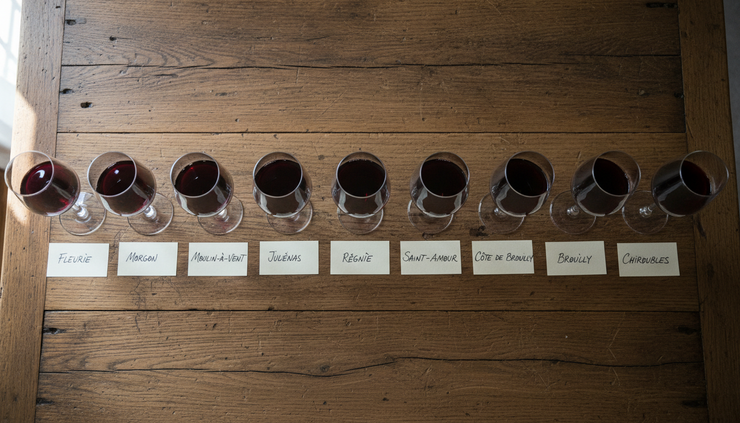
The ten appellations, from north to south, are generally listed as follows: Saint-Amour, Juliénas, Chénas, Moulin-à-Vent, Fleurie, Chiroubles, Morgon, Régnié, Brouilly, and Côte de Brouilly. Each has its own character, topography, and personality.
Each of the 10 Beaujolais crus has its own distinctive character
Saint-Amour charms visitors with its name and its charm
Saint-Amour is the northernmost appellation. Its name often brings a smile to people’s faces, especially around Valentine’s Day, a time when it experiences a noticeable surge in interest. But it would be unfair to reduce this appellation to its romantic image.
Its wines can be tender, fragrant, and elegant, with aromas of red berries, peony, violet, and sometimes a hint of sweet spices. Depending on the soil and winemaking techniques, Saint-Amour can also take on a more structured character, with a darker undertone and good body.
On the palate, it often offers a seductive balance between freshness, roundness, and delicacy. It is a wine meant for pleasure, but it is by no means a simple wine. The best vintages can age for several years.
Food & wine pairings
Saint-Amour pairs very well:
roast poultry with its own juices;
a pork tenderloin;
a pâté en croûte;
a mushroom risotto;
mild cheeses such as Saint-Marcellin or Brie.
Serve it slightly chilled, especially if it’s young. At around 13 to 14 °C, the fruit flavors come through without the alcohol overpowering them.
Juliénas displays a sunny and spicy character
According to tradition, Juliénas takes its name from Julius Caesar or the Roman presence in the region. The anecdote is appealing, even if the exact history is more nuanced. What is certain is that Juliénas is among the most expressive and robust crus.
Juliénas wines often have a deep color. They evoke black cherry, blackberry, and ripe strawberry, with hints of pepper, licorice, or dried flowers. Some exhibit an almost earthy note, which adds depth to the wine.
This cru often has more body than Saint-Amour. Yet it retains a lovely freshness, an essential hallmark of well-made Gamay. With a few years of aging, it can develop aromas of candied fruit, spices, and fine leather.
Food & wine pairings:
Juliénas pairs well with hearty dishes:
coq au vin;
brioché sausage;
grilled pork chops;
lamb tagine with prunes;
winter vegetable gratin.
It can handle slightly spicier dishes than the lighter Beaujolais wines. Decanting for 30 minutes helps younger vintages open up.
Chénas is understated, rare, and often surprising
Chénas is the smallest of the Beaujolais crus. This rarity gives it a special charm. Its name may derive from the oak trees that once grew there, before vines took over the hillsides.
Chénas wine often strikes a balance between floral finesse and substantial structure. It may offer aromas of peony, rose, cherry, and raspberry, followed by notes of spice, forest floor, or cocoa as it ages. It isn’t always the most approachable cru, but it rewards careful attention.
On the palate, it combines a fairly firm body with natural elegance. Tannins may be present when young, but they are never harsh if the wine is well-crafted. Chénas is best discovered off the beaten path.
Food & wine pairings
Chénas pairs well with:
pink duck breast;
a country-style terrine;
lentils with sausages;
sautéed porcini mushrooms;
a hard cheese such as young Comté.
For more ambitious vintages, wait two to five years. The wine will develop deeper nuances.
Moulin-à-Vent is the most Burgundian of all the crus
Moulin-à-Vent owes its name to an old mill, which is still visible today and has become one of the symbols of the Beaujolais region. This cru has a reputation all its own. It is often described as one of the most powerful, one of the best suited for aging, and one that most closely resembles certain Burgundian reds in character.
Its wines are deep, structured, and sometimes austere in their youth. Aromas range from black cherry to plum, with notes of violet, spices, licorice, warm stone, and sometimes truffle after aging. The granite soil here provides a firm and noble structure.
Moulin-à-Vent isn’t always a wine to open on a whim. It deserves time to breathe. Good bottles can age for a long time, developing remarkable complexity.
Food & wine pairings
Moulin-à-Vent calls for substantial dishes:
beef bourguignon;
duck with cherries;
grilled ribeye steak;
rabbit stew;
stuffed mushrooms.
Serve it between 15 and 16 °C, no higher. A temperature that’s too high makes the wine feel heavy and masks its finesse.

Fleurie Lives Up to Its Name
Fleurie is often described as the most “feminine” cru, even though this phrase is outdated and oversimplifies things. It’s better to say that it is one of the most floral, silky, and fragrant wines in the Beaujolais region.
Its aromas evoke rose, iris, violet, raspberry, fresh strawberry, and sometimes vine peach. On the palate, it captivates with its grace. The tannins are refined, the fruit is crisp, and the finish remains fresh.
Fleurie can be light and charming, but certain vintages from exceptional terroirs display real depth. The appellation includes several renowned climats, with styles that vary depending on exposure and elevation. For example: La Madone and Les Labourons.
Food and wine pairings:
Fleurie pairs elegantly with:
a Lyon-style salad;
roasted free-range chicken;
lightly seasoned beef tartare;
grilled vegetables;
a savory onion tart.
It’s an excellent choice when the meal includes several courses. Its suppleness ensures it doesn’t overpower the flavors.
Chiroubles offers freshness and high altitude
Chiroubles is the highest-altitude vineyard. This location often gives it a lively, airy, and very rich profile. The grapes ripen more slowly, which preserves their acidity and delicate aromas.
In the glass, Chiroubles evokes raspberry, red currant, crisp cherry, violet, and sometimes a hint of white pepper. On the palate, it is smooth, fresh, and elegant. It’s a wine you’ll want to drink without overthinking it, yet it’s not lacking in personality.
Chiroubles is perfect for understanding the concept of drinkability, in the best sense of the word. The wine glides down the throat, yet remains precise.
Food & wine pairings
Chiroubles pairs well with:
fine charcuterie;
parsley-crusted ham;
grilled fish served with a light red wine sauce;
chicken tacos;
fresh goat cheese.
It’s best served at around 12 to 13 °C. If served too warm, it loses its vibrancy. If served too cold, it becomes more austere.
Morgon donne des vins profonds et terriens
Morgon is one of the most famous crus. Its name is associated with the verb “morgonner,” used to describe the unique evolution of its wines. Over time, a Morgon often develops notes of kirsch, plum pit, plum, damp earth, and spices.
The appellation is partly situated on soils of weathered schist and altered rock (known as “blue stones”), particularly in the Côte du Py area. This hill is one of the most famous sites in Beaujolais (as seen in the wines of Jean Foillard or Louis-Claude Desvignes). It produces powerful, dense wines capable of aging with great elegance.
A young Morgon can already charm with its intense fruit. After a few years, it takes on a different character. It becomes more serious, more complex, and at times almost Burgundian in texture.
Food & wine pairings
Morgon pairs well with hearty dishes:
braised beef cheek;
Morteau sausage with lentils;
confit of lamb shoulder;
veal chop with morel mushrooms;
matured cheeses that aren’t too strong.
For a fine vintage, open the bottle an hour before serving. A decanter may be useful if the wine is young.
Régnié is the newest addition to the crus
Régnié was designated a cru later than the others, at the end of the 20th century. It is the newest member of the family, but it has no shortage of merits. Its style appeals with its freshness, immediate fruitiness, and balance.
Régnié wines often express notes of cherry, raspberry, red currant, and violet. They have a soft, round palate, sometimes with a hint of spice, and a supple finish. This cru is very approachable, even for those new to Beaujolais reds.
Its rolling terrain and granite soils produce clean, delicious wines that are more refined than heavy. Régnié often offers excellent value for money.
Food & wine pairings
Régnié pairs very well with:
quiche lorraine;
Basque-style chicken;
vegetable pizza;
beef carpaccio;
creamy cheeses.
It’s also a great choice for a chic picnic, paired with a terrine, country bread, and some marinated vegetables.
Brouilly is the largest and most approachable
Brouilly is the largest of the Beaujolais crus. It surrounds Mont Brouilly, though it is not to be confused with the Côte de Brouilly, which covers the slopes of this hill. This size explains the diversity of its styles.
In general, Brouilly produces fruity, supple, round, and approachable wines. They feature aromas of strawberry, cherry, and red plum, sometimes with a floral or peppery note. The palate is often generous, with few sharp edges.
Brouilly has long been the wine of large dinner parties. It retains this tradition. It is an easy-to-love cru, ideal for discovering Beaujolais without any pretension.
Food & wine pairings
Brouilly pairs well with:
rosette de Lyon;
roast chicken;
barbecued sausages;
gratin dauphinois;
homemade burgers.
Serve it slightly chilled. It also pairs well with simple meals, which is part of its charm.
Côte de Brouilly gains character on the slopes of Mont
Côte de Brouilly comes from the slopes of Mont Brouilly. Its volcanic soils (where the famous blue stones are found), which are often stonier, produce wines that are more taut and structured than those of Brouilly. The contrast between the two crus is very revealing.
In the glass, Côte de Brouilly may evoke black cherry, blueberry, violet, pepper, and a mineral quality. On the palate, it is straightforward and energetic, with lovely length. It is a cru that combines fruit and vibrancy.
It may seem a bit closed in its youth, especially with the more serious vintages. After two or three years, it softens and gains nuance.
Food & wine pairings
Côte de Brouilly pairs well with:
roast duck;
herb-crusted pork chops;
roasted root vegetables;
blood sausage with apples;
sheep’s milk cheese.
It is a splendid wine to pair with simple yet carefully prepared bistro cuisine.

How to choose a Beaujolais wine based on the style you’re looking for
Beaujolais wines become easier to understand when classified by taste profile. This classification is only a general guide, as the winemaker, vintage, and age of the vines can make a big difference. Still, it helps you choose a bottle that’s right for the occasion.
Desired style | Recommended Crus | Tasting notes |
Light, fresh, very fruité | Chiroubles, Régnié, Brouilly | Rasperry, red currant, cherry, supple tannins |
Floral and elegant | Fleurie, Saint-Amour, Chénas | Rose, violet, peony, silky texture |
Structured and deep | Morgon, Moulin-à-Vent, Juliénas | Black cherry, spices, licorice, good aging potential |
Taut and minéral | Côte de Brouilly, certains Chénas | Dark fruit, pepper, lively finish |
For a light dinner, a Chiroubles or a Fleurie will be perfect. For a slow-cooked meat dish, Morgon or Moulin-à-Vent will pair better. When choosing a bottle as a gift, Saint-Amour is appealing because of its name, but Chénas can be a pleasant surprise.
You should also consider the vintage. Sunny years produce richer, sometimes riper wines. Cooler years yield wines that are livelier and more elegant. No one style is superior to another. It all depends on the dish, the occasion, and the flavor profile you’re seeking. Among the most recent vintages, the warmer years are 2022, 2025, and 2026. The cooler years are 2021 and 2024. And 2023 was the most balanced vintage.
Best practices for tasting Beaujolais wines
A good Beaujolais wine should be tasted with care, but without excessive formality. These wines retain a convivial spirit. A few simple steps are all it takes to bring out their best qualities.
Serve them at the right temperature
Most red wines are served too warm. For Gamay, this is even more unfortunate. A Beaujolais wine is often best served between 12 and 16 °C, depending on its body.
Lighter wines, such as Chiroubles, Régnié, or Brouilly, are best enjoyed at a cool temperature, around 12 to 14 °C. Fuller-bodied wines, such as Morgon, Moulin-à-Vent, or Juliénas, can be served at 15 to 16 °C.
If the bottle is at room temperature in a heated room, place it in the refrigerator for 20 to 30 minutes before serving. This simple step makes all the difference.
Choose the adapted glass
A medium-sized red wine glass works very well. It should allow the wine to breathe without dispersing the aromas. Avoid tiny glasses, which trap the bouquet.
For floral wines, a Burgundy-style glass can accentuate the aroma. For more robust wines, a slightly narrower glass helps concentrate the fruit and spices.
Let the more serious vintages breathe
Not all Beaujolais wines need to be decanted. A young Brouilly or a fruity Régnié can be served straight from the bottle. On the other hand, a full-bodied Morgon, Moulin-à-Vent, Juliénas, or Côte de Brouilly can benefit from being allowed to breathe.
The decanter isn’t meant to impress. It helps the wine open up. Thirty minutes is often enough. For an older bottle, it’s best to err on the side of caution and pour gently, as too much aeration can tire the wine.
Try it when it's young then try it again as it ages
Beaujolais offers immediate enjoyment, but some vintages age very well. To understand how they evolve, buy two or three bottles of the same vintage. Open one while it’s young, then save the others.
After a few years, the fresh fruit flavors may give way to notes of kirsch, spices, dried flowers, forest floor, or cocoa. This transformation explains why wine lovers speak of these wines with such affection.
Serve them with a delicious meal
Gamay pairs well with simple, hearty dishes. It goes well with roasted meats, poultry, cold cuts, mushrooms, mild cheeses, and even certain fish. Its freshness cleanses the palate. Its tannins, which are often delicate, do not make the textures feel harsh.
For a full meal, here are some suggestions:
Chiroubles with gougères or fine charcuterie;
Fleurie with roasted poultry;
Morgon with braised meat;
Moulin-à-Vent with a mature cheese;
Saint-Amour with a lightly sweetened red fruit tart, provided the wine remains supple and fruity.
The most useful rule is simple: the more robust the dish, the more structure the wine should have.
What to keep in mind before opening a bottle
Beaujolais wines prove that Gamay can be lively, refined, deep, and complex. Saint-Amour charms, Juliénas asserts itself, Chénas intrigues, Moulin-à-Vent impresses, Fleurie is fragrant, Chiroubles is refreshing, Morgon develops character over time, Régnié is welcoming, Brouilly brings people together, and Côte de Brouilly gains depth.
To truly discover them, start with three bottles with contrasting profiles: a Fleurie for floral elegance, a Morgon for depth, and a Chiroubles or a Régnié for freshness. Then add a Moulin-à-Vent if you like wines with aging potential, followed by a Chénas if you’re looking for a more niche appellation.
Beaujolais crus don’t have to be complicated to be exciting. They just require a little curiosity, the right serving temperature, and a welcoming table. Open a bottle, take in the fruit, flowers, and spices, then let the terroir speak for itself.
Want to discover the Beaujolais crus through a private, tailor-made tour with an expert guide on the region’s wines? Check out the offer below:


Comments